

The Complete Colorado Home Buyer's Guide
Everything You Need to Know About Buying a Home in Colorado — From Pre-Approval to Getting the Keys
Buying a home is exciting.
It can also feel overwhelming.
How much home can I afford? How much money do I need for a down payment? What credit score do I need? Should I choose an FHA, conventional, VA, or another type of mortgage? What are closing costs? When should I get pre-approved? And how do I know I'm getting the right mortgage?
Take a breath. We've got you.
At 5280 Financial Group, we've spent 25 years helping Colorado homebuyers navigate the mortgage and home-buying process.
We've created this Colorado Home Buyer's Guide to take away some of the mystery and explain the process in plain English—from the moment you start thinking about buying a home until somebody puts the keys in your hand.
And here's the most important thing to understand before we begin:
You don't need to know everything about buying a home. You just need the right people around you who do.
THE ROAD HOME
Thinking → Pre-Approval → House Hunting → Offer → Underwriting → Clear-to-Close → KEYS!
Step 1: Start With the Mortgage — Not the House
One of the biggest mistakes prospective homebuyers make is looking at homes before understanding their financing.
It's fun to scroll through homes online.
But before falling in love with a $600,000 house, let's determine whether $600,000 is the right number for you.
That's why the first step should be talking with an experienced mortgage broker here at 5280 Financial Group and getting pre-approved.
A good mortgage pre-approval should help answer:
How much home can I comfortably afford?
What will my estimated monthly payment be?
How much money will I need at closing?
Which mortgage program makes the most sense for me?
Is there anything we should improve before I start making offers?
At 5280 Financial Group, we don't believe a pre-approval should simply tell you the maximum amount a computer says you can borrow.
We want to help determine a housing payment that makes sense for your life.
Qualifying for a mortgage and comfortably affording a mortgage aren't always the same thing.
Step 2: Understanding Mortgage Pre-Approval
A mortgage pre-approval gives you an estimate of what you may qualify to borrow based on factors including your income, employment, assets, debts and credit profile.
Your pre-approval can also make you a stronger buyer when you're ready to submit an offer.
Depending on your situation, your mortgage professional may request documents such as:
- Recent pay stubs
- W-2s and/or tax returns when applicable
- Bank or asset statements
- Identification
- Employment information
- Information about existing debts or properties
Self-employed?
Don't automatically assume qualifying will be difficult.
There are mortgage programs specifically designed for different income situations, including traditional conventional financing and alternative programs such as bank statement loans for certain qualified borrowers.
Talk with us before assuming you don't qualify.
BEFORE YOU GO HOUSE SHOPPING
✓ Know your buying power
✓ Understand your payment
✓ Estimate cash needed to close
✓ Review your credit
✓ Choose a mortgage strategy
✓ Get PRE-APPROVED
✓ Understand your payment
✓ Estimate cash needed to close
✓ Review your credit
✓ Choose a mortgage strategy
✓ Get PRE-APPROVED
Then go find the house.
Step 3: How Much House Can You Afford?
There isn't one universal answer.
Your purchasing power can depend on:
- Gross monthly income
- Monthly debt obligations
- Credit history and credit score
- Available assets
- Down payment
- Property taxes
- Homeowners insurance
- HOA dues, when applicable
- Mortgage interest rate
- Mortgage insurance, when applicable
- Loan program
Lenders commonly evaluate your debt-to-income ratio (DTI), which compares qualifying monthly debt obligations with qualifying gross monthly income.
But we believe there's another question that's just as important:
What payment are YOU comfortable with?
Your mortgage should fit into your life—not consume it.
That's why we'll discuss both qualification and comfort when building your mortgage strategy.
Step 4: You May NOT Need 20% Down
This remains one of the biggest home-buying myths.
You don't necessarily need 20% down to purchase a home.
Depending upon eligibility and loan guidelines, homebuyers may have access to options including:
Conventional Loans
Some conventional programs allow qualified buyers to purchase with as little as 3% down. Conventional loans require a 620+ credit score.
FHA Loans
FHA financing may allow qualified borrowers to purchase with 3.5% down, subject to FHA requirements. FHA will go as low as a 580 credit score.
VA Home Loans
Eligible veterans, active-duty service members and certain surviving spouses may qualify for VA financing with no down payment required, subject to program requirements.
Down Payment Assistance
Certain Colorado buyers may qualify for down payment assistance programs that can help with the upfront costs associated with purchasing a home. You can get into a home with as little as $1,000.
Gift Funds
You can use gift funds from a relative for your downpayment, and your closing costs.
The right choice isn't necessarily the loan requiring the smallest down payment.
It's the mortgage structure that best fits your finances, goals and future plans.
HOME BUYING MYTH
"I need 20% down."
NOPE.
Qualified buyers may have options with:
3% DOWN | 3.5% DOWN | VA 0% DOWN | DOWN PAYMENT ASSISTANCE
Eligibility and program requirements apply.

Step 5: Credit — Don't Assume Your Score Isn't Good Enough
Another common mistake is waiting to speak with a mortgage professional because you're worried about your credit.
Talk to us first.
Your credit score is only one part of your mortgage profile, and requirements vary considerably between mortgage programs.
More importantly, if your credit isn't where it needs to be today, we can help identify what may be preventing you from qualifying and discuss potential steps toward becoming mortgage-ready.
Sometimes the difference between "not yet" and "yes" is simply having a plan.
Don't spend months randomly paying off accounts, closing credit cards or moving money around because something on the internet told you to.
Call us and we will review the entire picture first.
Step 6: Choosing the Right Mortgage
There's no such thing as the "best mortgage" for everybody.
There is a mortgage that's best suited to your particular situation.
5280 Financial Group offers access to a wide variety of mortgage solutions, including:
Conventional Loans — Popular financing for qualified homebuyers with flexible down-payment options.
FHA Loans — Government-insured financing that can provide additional flexibility for certain borrowers.
VA Loans — Powerful mortgage benefits for eligible veterans and service members.
Jumbo Loans — Financing options for homes exceeding applicable conforming loan limits.
Bank Statement Loans — Alternative financing options that may help certain self-employed borrowers.
Investment Property Loans — Financing designed for real estate investors. DSCR loans are very popular.
Down Payment Assistance — Programs designed to help eligible homebuyers with upfront home-buying costs, and as little as $1,000 down.
Temporary Rate Buydowns — Strategies that can temporarily reduce the buyer's interest rate/payment during the initial 1 to 2 years of the mortgage when properly structured.
This is one reason working with a mortgage broker here at 5280 Financial Group can be valuable.
Instead of trying to make every borrower fit into one box, we can evaluate multiple financing options and help determine which strategy fits your situation.
Step 7: Find the Right Colorado Real Estate Agent
Your lender is only one part of your home-buying team.
A great real estate agent can help you:
- Identify homes matching your criteria
- Understand neighborhoods
- Evaluate comparable sales
- Structure an offer
- Negotiate with sellers
- Navigate inspections
- Manage contract deadlines
- Coordinate the transaction through closing
And local knowledge matters.
Someone who understands Parker may provide different insight than someone specializing in Denver, Castle Rock, Highlands Ranch, Littleton, Lakewood, Arvada, Golden or Colorado Springs.
If you don't already have a real estate agent, 5280 Financial Group can help connect you with experienced Colorado real estate professionals who know the specific area where you want to buy.
Not simply an agent.
The right agent for the area.

YOU DON'T BUY A HOME ALONE.
YOU at the center.
Surrounded by:
- Real Estate Agent
- Mortgage Broker
- Home Inspector
- Insurance Professional
- Title/Closing Team
- 5280 Financial Group
- Mortgage Broker
- Home Inspector
- Insurance Professional
- Title/Closing Team
- 5280 Financial Group
The right team can change the entire experience.
Step 8: It's Time to Go House Hunting
Now the fun begins.
Once you're pre-approved and working with an agent, you can start seriously looking at homes.
But don't focus only on the purchase price.
Consider the complete picture:
Location. Property taxes. HOA costs. Insurance. Commute. Schools when relevant. Future plans. Maintenance. Potential improvements. Resale considerations.
And most importantly:
How does the home fit your life?
A house isn't simply an investment.
It's where Saturday mornings happen.
It's where Thanksgiving dinner happens.
It's where dogs destroy carpets, kids grow up, friends gather and memories are created.
Numbers matter.
But so does life.
Step 9: Making an Offer
You found it.
Now what?
Your real estate agent will help determine an appropriate offer strategy based on the property, comparable sales, market conditions and your goals.
An offer may address more than purchase price.
Depending on the transaction, negotiations could involve:
- Purchase price
- Closing date
- Earnest money
- Seller concessions
- Inspection provisions
- Financing terms
- Appraisal considerations
- Other contractual terms
This is also where having a responsive lender matters.
Real estate doesn't operate exclusively Monday through Friday from 9–5.
Neither do we.
5280 Financial Group is available 18/7, because sometimes the house you want shows up Saturday afternoon and offers are due Sunday.
Step 10: Under Contract! What Happens Now?
Congratulations.
Your offer was accepted.
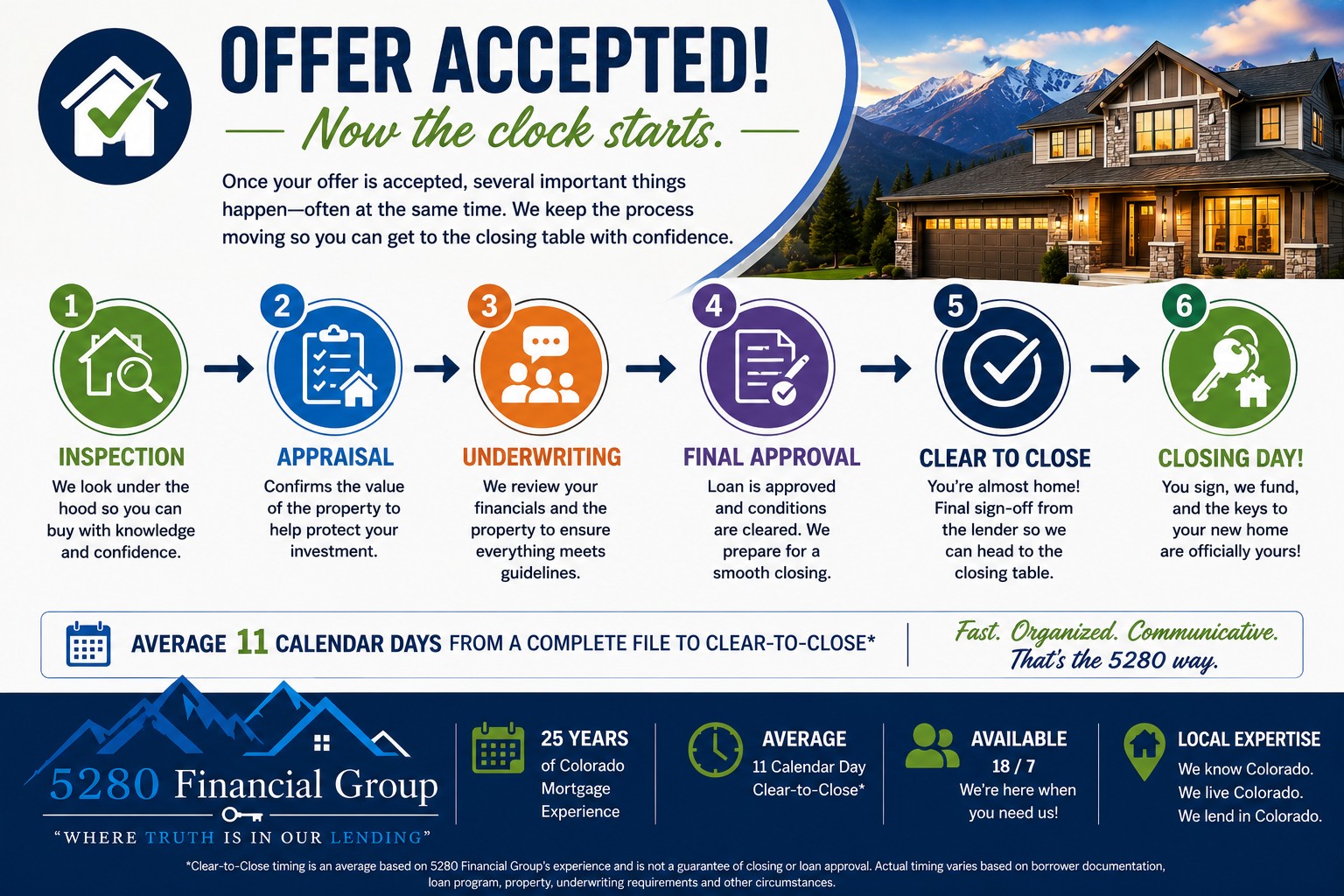
Now several things begin happening—often simultaneously.
Your lender begins moving the mortgage toward final approval.
Your real estate agent manages contractual deadlines.
Inspections may be performed.
Homeowners insurance is arranged.
The appraisal may be ordered.
Title work is reviewed.
Your financial documents move through underwriting.
This is where communication and organization become extremely important.
At 5280 Financial Group, we average approximately 11 calendar days from a complete file to Clear-to-Close.*
Because once you're under contract, nobody wants to wonder what's happening with their mortgage.
OFFER ACCEPTED!
Now the clock starts.
Inspection → Appraisal → Underwriting → Final Approval → CLEAR TO CLOSE
5280 Financial Group
Average Clear-to-Close: 11 Calendar Days*
Step 11: The Home Inspection
A home inspection and a mortgage appraisal serve very different purposes.
A home inspection is generally designed to help you better understand the physical condition of the property.
A home inspection fee is paid upfront.
Depending on the property and inspection scope, an inspector may evaluate areas such as:
- Roof
- Electrical systems
- Plumbing
- Heating and cooling
- Foundation
- Appliances
- Windows and doors
- Attic/crawlspace
- Safety concerns
Your real estate professional can help you understand your inspection rights and contractual deadlines.
Step 12: The Appraisal
An appraisal is different.
The lender may require an appraisal to help determine whether the property's value adequately supports the mortgage transaction.
The appraiser typically evaluates the property and analyzes relevant comparable sales and market information.
An appraisal isn't the same thing as a home inspection.
The appraisal cost is paid upfront.
Think of it this way:
Inspection = What's the condition of the house?
Appraisal = What does the property support as an opinion of market value?
Step 13: Mortgage Underwriting
"Underwriting" sounds intimidating.
It really shouldn't.
The mortgage underwriter reviews your loan file to determine whether it meets applicable lending and program requirements.
They may review:
Income + Assets + Credit + Property + Loan Program
Sometimes an underwriter requests additional documentation.
That's normal.
The most important thing you can do during this stage is respond quickly and don't make significant financial changes without speaking with your mortgage professional.
Which brings us to something extremely important...
DON'T DO THIS BEFORE CLOSING!
Once you're pre-approved or under contract:
Don't finance a new car.
Don't open new credit cards.
Don't make large unexplained deposits.
Don't quit or change jobs without talking with us.
Don't move large amounts of money between accounts without discussing documentation.
Don't co-sign a loan for someone.
Don't run up your credit-card balances furnishing the house you haven't closed on yet.
And please...
DON'T BUY THE NEW TRUCK THE WEEK BEFORE CLOSING.
We've seen it.
Call us first.
A five-minute conversation can potentially prevent a major mortgage problem.
THE "DON'T MESS UP MY MORTGAGE" LIST
- New Car
- New Credit
- New Furniture Financing
- Large Unexplained Deposits
- Job Changes Without Calling Us
- Co-Signing Loans
- New Credit
- New Furniture Financing
- Large Unexplained Deposits
- Job Changes Without Calling Us
- Co-Signing Loans
BEFORE MAKING A BIG FINANCIAL MOVE:
CALL 5280 FIRST.

Step 14: CLEAR TO CLOSE!
These are three of our favorite words:
CLEAR. TO. CLOSE.
Clear-to-Close generally means the mortgage has received the necessary final lending approval to proceed toward closing, subject to any remaining closing requirements.
Now the closing team prepares final documents and coordinates the transaction for closing.
You'll also receive your applicable closing disclosures according to federal requirements, giving you an opportunity to review the final loan terms and costs.
Here at 5280 Financial Group will take the time to review the most important documents you will see the day of closing at least 24 hours before, so that you can see that no surprises will arise the day of closing, just a celebration.
And then...
It's time.
Step 15: Closing Day — Welcome Home
You've made it.
At closing, you'll review and sign the required documents, complete the transaction and, once all applicable requirements are satisfied...
Those keys become yours.
Think back to where you started.
Maybe you weren't sure whether you could qualify.
Maybe you thought you needed 20% down.
Maybe you were worried about your credit.
Maybe you didn't understand mortgages at all.
And now?
You're a homeowner.
That's why we do what we do.
Why Colorado Homebuyers Choose 5280 Financial Group
A mortgage isn't simply an interest rate.
It's strategy.
It's communication.
It's experience.
It's knowing what to do when something doesn't go according to plan.
And after 25 years in Colorado mortgage lending, we've seen a lot.
At 5280 Financial Group, our goal is to make home financing understandable, transparent and—believe it or not—even enjoyable.
What Makes 5280 Different?
25 Years of Colorado Mortgage Experience
We've spent decades helping buyers navigate changing interest rates, changing housing markets and changing lending guidelines.
Average 11-Calendar-Day Clear-to-Close*
Speed matters—especially once you're under contract.
Available 18/7
Real estate doesn't stop at 5:00 PM. Neither do we.
Mortgage Broker Advantage
We can evaluate options from multiple lending sources rather than limiting every borrower to one lender's product menu.
Creative Mortgage Strategies
Sometimes getting someone home requires more than simply quoting an interest rate. We look at the entire financial picture.
Colorado Local Expertise
We're not a call center thousands of miles away.
Personal Service
You'll know who's handling your mortgage and what's happening with your loan because you only deal with two people from start to finish.
Buying a Home Starts With a Conversation — Not an Application
Here's something important.
You don't have to be ready to buy today to talk with us today.
Maybe you're buying next month.
Maybe six months from now.
Maybe next year.
That's okay.
In fact, the earlier we talk, the more time we have to create a strategy.
We can discuss:
Where are you today?
Where would you like to be?
What's standing between the two?
Then we'll help create the roadmap.
No pressure.
No obligation.
Just information.
Ready to Start Your Colorado Home-Buying Journey?
Let's find out what's possible.
Talk with 5280 Financial Group today about your mortgage options, buying power and next steps toward owning a home in Colorado.
GET PRE-APPROVED
5280 Financial Group
Where TRUTH is in our LENDING.
Colorado Home Buyer FAQ
1. How much money do I need to buy a house in Colorado?
It depends on the mortgage program, purchase price, closing costs and your individual financial situation. Some qualified buyers may be eligible for conventional financing with as little as 3% down, FHA financing with 3.5% down, VA financing with no required down payment, or eligible down-payment-assistance programs. You can even receive gift funds from a relative to cover your downpayment and even all your closing costs. Your mortgage professional can calculate your estimated total cash needed before you begin shopping.
2. Do I need 20% down to buy a home?
No. Twenty percent down is not universally required. Many qualified homebuyers purchase homes with substantially less. Putting 20% down can have advantages in certain situations, but the best down-payment strategy depends on your finances and goals.
3. What credit score do I need to buy a house in Colorado?
Credit requirements depend on the loan program, lender and overall borrower profile. Don't assume your credit prevents you from buying. A mortgage review can determine which options may currently be available and what steps might improve your eligibility. We can go as low as 580 on FHA and VA, 620 for Conventional and DPA.
4. Should I get pre-approved before looking at homes?
Generally, yes. Getting pre-approved before seriously house hunting helps establish your purchasing range, estimated payment, cash requirements, saves a lot of time, and financing strategy. It can also help demonstrate to sellers that you've taken steps toward securing financing.
5. How long does mortgage pre-approval take?
We have same-day pre-approvals. Timing varies depending on the complexity and completeness of the borrower's information. Having income, employment, asset and other requested documentation readily available can make the process much faster.
6. What's the difference between mortgage pre-qualification and pre-approval?
Terminology and processes vary by lender, but a pre-qualification may rely on more preliminary information, while a pre-approval generally involves a more detailed review of the borrower's financial profile and credit.
7. What are closing costs when buying a home?
Closing costs can include lender fees, title-related charges, appraisal costs, prepaid property taxes, homeowners insurance, interest and other transaction expenses. Your specific costs depend on your mortgage, property, and if you can get seller-concessions to help pay for some or all closing costs (this is were a recomended, seasoned Real Estate agent becomes valuable).
8. Can the seller pay my closing costs?
Certain mortgage programs permit seller concessions subject to applicable guidelines and transaction terms. Your mortgage broker and real estate agent can help determine what's permitted and whether requesting concessions makes sense for your transaction.
9. Is FHA or conventional financing better?
Neither is universally better. FHA may be advantageous for some borrowers, while conventional financing may make more sense for others. Credit, down payment, mortgage insurance, property type and long-term goals should all be considered.
10. Can first-time homebuyers receive down payment assistance in Colorado?
Qualified borrowers may have access to Colorado down-payment-assistance programs. Eligibility requirements vary, so the best first step is determining which programs may apply to your particular situation.
11. Can I buy a home if I'm self-employed?
Absolutely. Self-employed borrowers purchase homes every day. Documentation and income calculations can differ from those used for salaried borrowers, and alternative mortgage programs may also be available for certain situations.
12. What is debt-to-income ratio?
Debt-to-income ratio, commonly called DTI, compares applicable monthly debt obligations with qualifying gross monthly income. Lenders use DTI as one factor when determining mortgage eligibility.
13. Does getting pre-approved hurt my credit?
The credit impact depends on the type of inquiry and credit-scoring circumstances. Ask your mortgage professional whether the initial review uses a soft or hard credit inquiry and when a full credit report will be required.
14. How long does it take to close on a house?
Closing timelines vary based on the transaction, mortgage program, property and documentation. 5280 Financial Group averages approximately 11 calendar days from a complete file to Clear-to-Close.*
15. Should I use a Colorado mortgage broker instead of a bank?
It depends on your needs. A mortgage broker can evaluate financing through multiple lending sources and help compare different mortgage structures. A bank generally offers products available through that institution. Buyers who value multiple options and personalized mortgage strategy may find working with an experienced mortgage broker beneficial.
16. Can I buy a home while relocating to Colorado?
Yes. Buyers relocating to Colorado can often complete much of the mortgage process remotely, including pre-approval and documentation. Working with professionals who understand Colorado real estate and relocation financing can make coordinating an out-of-state move easier.
17. When should I talk to a mortgage broker if I want to buy next year?
Now can be an excellent time. Starting early gives you an opportunity to review credit, savings, debt, income and potential loan options before you're under pressure to make an offer.
18. What's the first step to buying a house in Colorado?
Start with a conversation.
Before worrying about houses, interest rates or down payments, find out where you stand financially and what options may be available.
That's exactly what we're here to help you do.
Start Your Colorado Home Buying Journey Today
Whether you're a first-time homebuyer in Colorado, moving into your next home, relocating to Colorado, buying an investment property or simply wondering whether homeownership is possible...
Let's talk.
You might be closer to owning a home than you think.
5280 FINANCIAL GROUP
25 Years of Colorado Mortgage Experience | Available 18/7 | Average 11-Calendar-Day Clear-to-Close*
WHERE TRUTH IS IN OUR LENDING.
[GET PRE-APPROVED] | [TALK WITH A MORTGAGE EXPERT]
*Clear-to-Close timing is an average based on 5280 Financial Group's experience and is not a guarantee of closing or loan approval. Actual timing varies based on borrower documentation, loan program, property, underwriting requirements and other circumstances. Loan programs, terms, down-payment requirements and eligibility are subject to applicable guidelines and qualification. This information is for educational purposes and is not a commitment to lend.