
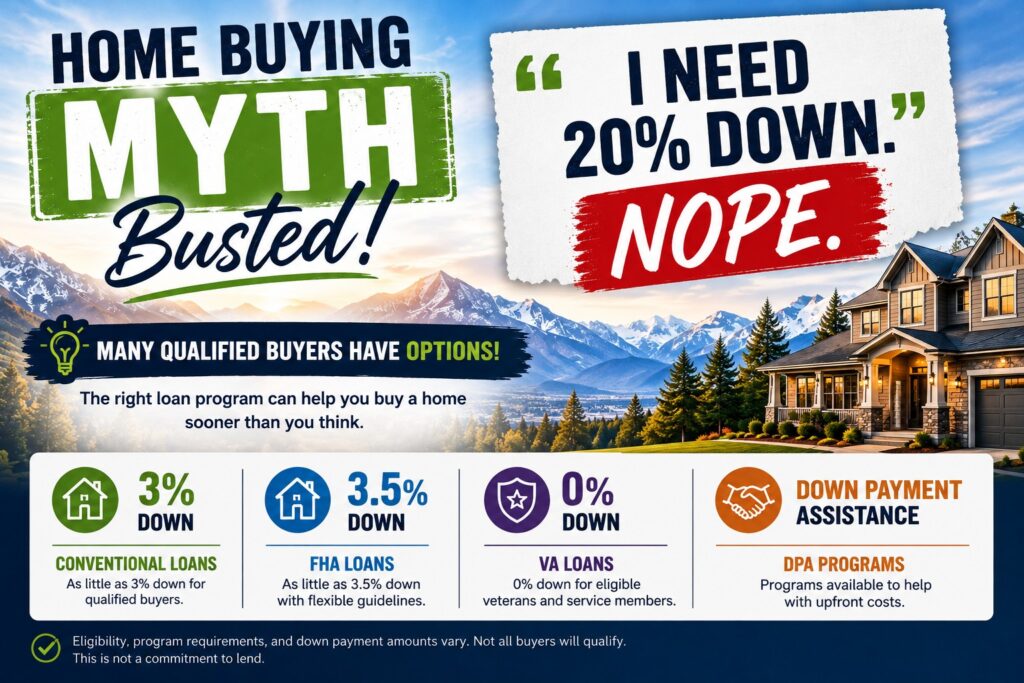
Do You Really Need 20% Down to Buy a House in Colorado? MYTH BUSTED!
Think You Need a Fortune Saved to Buy Your First Home? Think Again!
Have you ever been looking at homes for sale in Colorado, spotted one you absolutely loved, and thought, "Man, I'd LOVE to own a place like that someday!"
Then you start doing the math.
A $450,000 home with 20% down means you'd need $90,000.
NINETY THOUSAND DOLLARS?!
And just like that, your dream of homeownership gets pushed another five or ten years down the road.
But hold on a minute!
Before you count yourself out, let's talk about some questions people ask all the time.
"Do I really need 20% down to buy a house in Colorado?"
"Can I buy my first home with just 3% down?"
"What's the difference between an FHA loan and a conventional loan?"
"Can veterans buy a home with zero down?"
"Does Colorado have programs to help with down payments?"
"If I put less than 20% down, will I have to pay mortgage insurance?"
"Should I buy with a smaller down payment or wait until I've saved more?"
Sound familiar?
Well, I've got some pretty encouraging news!
YOU DO NOT NECESSARILY NEED 20% DOWN TO BUY A HOUSE!
Depending on your qualifications, you may be able to purchase with as little as 3% down, 3.5% down, or even zero down with certain mortgage programs.
And Colorado has assistance programs that may help eligible buyers with upfront costs.
Let's take a look at your options!
1. Conventional Loans — As Little as 3% Down
Here's something that surprises a LOT of people.
Certain conventional mortgage programs allow qualified buyers to purchase with as little as 3% down!
Let's say you're buying a $400,000 home.
A traditional 20% down payment would be $80,000.
With a qualifying 3% down conventional loan?
Your down payment could be just $12,000!
That's a $68,000 difference!
Of course, you'll still need to account for closing costs and other expenses. And certain programs have income limits or additional eligibility requirements.
But here's my point: Don't assume you need years of savings before you can start exploring homeownership.
Troy's Take: Sometimes it's not about saving more money. It's about understanding the financing options you already have!
2. FHA Loans — As Little as 3.5% Down
If your credit isn't perfect or you have limited savings, an FHA loan might be worth exploring.
FHA loans are government-insured mortgages that can offer more flexible qualification guidelines for certain borrowers.
Eligible buyers can purchase with as little as 3.5% down.
On that same $400,000 home, your down payment would be $14,000.
FHA loans do have mortgage insurance requirements and other program guidelines, so they're not automatically the right choice for everyone.
That's why I like comparing FHA and conventional financing side by side.
Troy's Take: Your credit score doesn't tell your entire story. Let's look at the whole picture before deciding what makes sense.
3. VA Loans — Zero Down for Eligible Buyers
To our veterans, active-duty service members, and eligible surviving spouses, here's a benefit worth knowing about!
Qualified borrowers may be able to purchase a home with ZERO down using a VA-backed mortgage.
On a $400,000 home, that could mean:
$0 down payment!
Now, zero down doesn't necessarily mean zero closing costs.
And depending on your eligibility, there may be a VA funding fee unless you're exempt.
But VA financing generally doesn't require monthly mortgage insurance, which is another benefit worth considering.
Troy's Take: If you've earned the VA home loan benefit, let's make sure you understand how to put it to work for YOU!
4. Colorado Down Payment Assistance — Help With Upfront Costs
Maybe your income is solid, your credit is in good shape, and you're managing your bills just fine.
But saving thousands of dollars while paying rent, groceries, car payments, and everything else?
That's another story!
Fortunately, Colorado offers down payment assistance programs for eligible homebuyers.
One option is through the Colorado Housing and Finance Authority (CHFA), which offers qualifying buyers mortgage programs that may include assistance with down payments and closing costs.
Some assistance comes in the form of grants, while other programs use second mortgages that may require repayment.
And here's something important:
Not all down payment assistance is free money!
We need to compare the interest rates, payments, program requirements, and long-term costs before deciding what makes sense.
Troy's Take: Just because assistance is available doesn't automatically mean it's your best option. Let's run the numbers first!
5. How Much Down Payment Would You Actually Need?
Let's put some real numbers on the table!
| Home Price | 3% Conventional | 3.5% FHA | 0% VA |
| $350,000 | $10,500 | $12,250 | $0 |
| $400,000 | $12,000 | $14,000 | $0 |
| $450,000 | $13,500 | $15,750 | $0 |
| $500,000 | $15,000 | $17,500 | $0 |
| $600,000 | $18,000 | $21,000 | $0 |
Illustrative down payment amounts only. Closing costs, prepaid expenses, and other cash requirements are additional. Eligibility and loan limits apply.
Look at that $500,000 home.
With 20% down, you'd need $100,000.
With an eligible 3% down conventional mortgage?
Just $15,000 toward your down payment!
That's an $85,000 difference in money needed upfront for the down payment.
Pretty eye-opening, isn't it?
6. What About Mortgage Insurance and Closing Costs?
Here's where we need to look at the whole picture.
When you put less than 20% down on a conventional mortgage, you'll typically have private mortgage insurance (PMI). FHA loans generally require mortgage insurance premiums, too.
VA loans generally don't require monthly mortgage insurance.
And remember, your down payment isn't the same thing as your total cash needed to close.
You may also have appraisal fees, title costs, homeowners insurance, prepaid taxes, and other expenses.
Some buyers may qualify for assistance, eligible gift funds, or seller concessions to help with certain costs.
Troy's Take: I don't want you surprised by your mortgage payment OR the money needed at closing. Let's look at all the numbers before making a decision.
7. Should You Buy With Less Down or Wait Until You've Saved 20%?
Now THAT'S a great question!
And the answer?
It depends on YOU!
A larger down payment generally means a smaller loan balance, potentially lower monthly payments, and less spent on interest over time.
But a smaller down payment may allow you to keep more savings for emergencies, repairs, and other financial priorities.
Neither strategy is automatically better.
We need to compare the costs, payments, and your financial comfort level.
Troy's Take: The goal isn't necessarily to put the least money down. It's to make the smartest decision for YOUR financial situation.
The Bottom Line — Don't Let the 20% Myth Keep You on the Sidelines!
Here's what I want you to remember.
You don't necessarily need perfect credit.
You don't necessarily need 20% down.
And you don't need to have every answer before starting a conversation.
Depending on your circumstances, conventional loans, FHA loans, VA financing, and Colorado down payment assistance programs may offer options you didn't realize existed.
Does everyone qualify? No.
But should you automatically assume buying a home is out of reach?
ABSOLUTELY NOT!
I've spent 25 years helping Colorado homebuyers explore their options, and one of my favorite parts of this business is showing someone that a goal they thought was years away might be closer than they imagined.
Sometimes we find a solution that works today.
Other times, we put together a plan to help them get there.
Either way, we're moving in the right direction!
At 5280 Financial Group, we LISTEN first and LEND second.
Ready to See What's Possible?
Before you spend another year thinking you need a fortune saved to buy a house, let's have a conversation!
We'll look at your finances, explore your mortgage options, and figure out what makes sense for you.
No pressure. No complicated mortgage jargon. Just honest answers and a plan.
DON'T LET WHAT YOU THINK YOU NEED KEEP YOU FROM FINDING OUT WHAT'S ACTUALLY POSSIBLE!